AEO (Answer Engine Optimization) means building trust for your brand across the whole web.
Do this well, and AI platforms like ChatGPT, Perplexity, and Google’s AI Overviews will cite or recommend you. This can happen even when your own website doesn’t rank for the keyword.
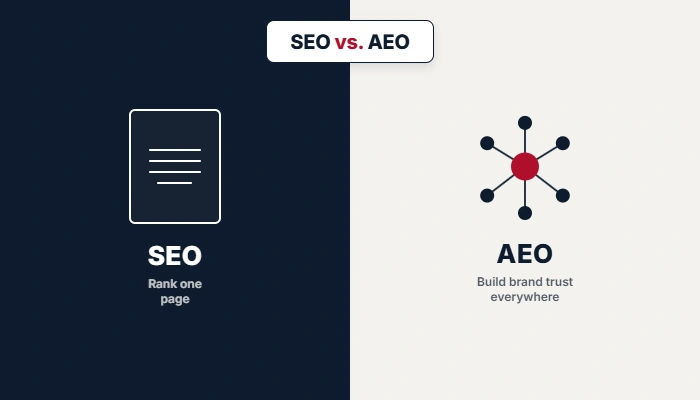
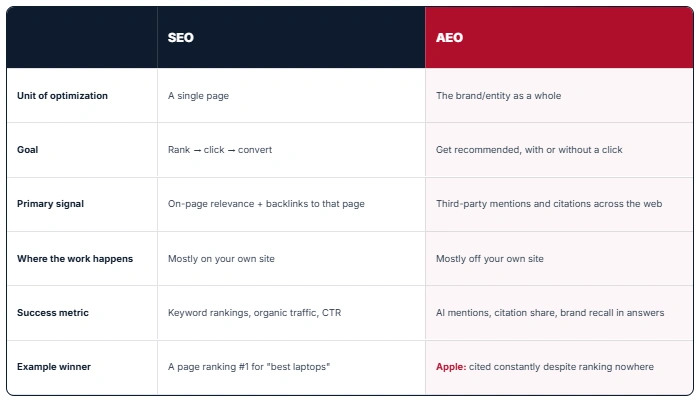
SEO works differently. SEO is page-centric: you build one page, target one keyword, and try to rank it in traditional search.
It’s built to match a searcher’s intent for that keyword. AEO is entity-centric: it’s about your brand’s overall credibility, not any single page.
The clearest way to see the difference is a brand that shouldn’t be visible by traditional SEO standards. Yet it’s everywhere in AI answers anyway.
The Apple problem: ranking nowhere, dominating everywhere
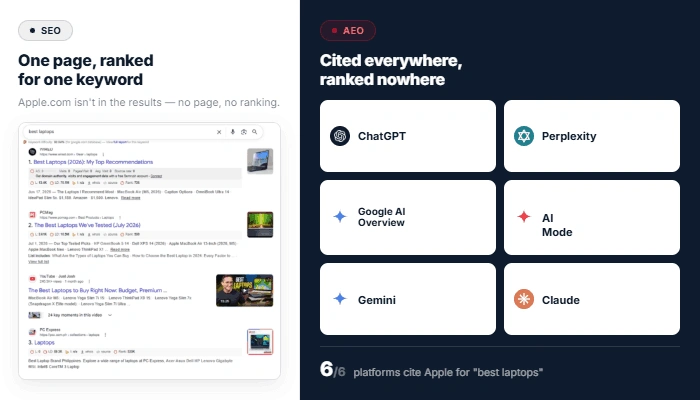
Search “best laptops” on Google and apple.com doesn’t show up in the traditional organic results. By page-level SEO logic, Apple should be invisible for that query.
But ask ChatGPT, Perplexity, Google AI Overviews, AI Mode, Gemini, or Claude the same question. Apple dominates the answer.
That’s not because apple.com is optimized for “best laptops.” It isn’t trying to be. Apple dominates because third parties mention it constantly.
Those mentions sit on the exact pages AI platforms pull citations from.
That’s the whole distinction in one example. SEO ranks pages.
AEO builds brand trust. That’s the kind that gets you cited even if your own page never ranks.
SEO vs. AEO at a glance
SEO isn’t obsolete. It’s the foundation.
A brand with strong traditional SEO has an easier time earning AEO visibility, because the same authority-building work (getting cited, linked, and mentioned by credible third parties) feeds both. They’re not competing strategies.
AEO is a layer built on top of SEO, not a replacement for it.
Why this isn’t just a rebrand of SEO
It’s tempting to wave this off as a marketing relabel. But there’s a real counter-example worth addressing: Nudie Jeans.
This denim brand gets cited in roughly 90% of AI answers for its core term. Yet it ranks dismally in traditional search: around position 28 on Brave, and weak on Google.
At first glance, that looks like proof AEO doesn’t need SEO at all.
Here’s the catch: Nudie Jeans’ own website isn’t even one of the sources AI platforms pull from for that query. Researchers identified 35 citation sources for the term.
The brand’s own site wasn’t among them. But the brand’s name showed up across 14 of those 35 sources (40% coverage).
That coverage came from a heavily funded influencer, affiliate, and PR program, including a New York Times placement.
So the “SEO doesn’t matter” read is wrong. Here’s the accurate read: on-site SEO for that one page didn’t matter.
The visibility came from being mentioned everywhere else instead. That’s still SEO, just in the broader sense of search everywhere optimization.
It’s not narrowly about whether your own page ranks.
The 80-90% off-site rule
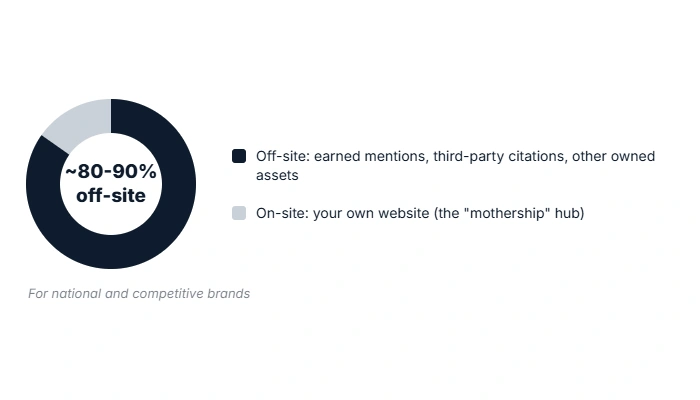
For national or competitive brands, the recommended split is roughly 80-90% of AEO effort off your own website. That means earned mentions, third-party citations, and other owned assets like YouTube or LinkedIn.
The rest goes to your own site: the “mothership” hub.
That ratio flips for local businesses. For a local service business, Google Business Profile can drive 80-90% of what fuels Google’s AI citations.
Why? Local businesses get cited directly, not mainly through third-party editorial coverage.
One caveat: ChatGPT doesn’t use GBP data. It cites third-party directories directly instead.
So this specific lever doesn’t carry over to every AI platform.
How AI platforms actually source citations
It helps to know where AI answers actually pull from. That changes where you point your effort.
Citation sets shift day-to-day. But track them over several months, and a stable core tends to emerge: roughly 5-7 recurring sources per query.
Those recurring sources are your highest-priority outreach targets. Don’t chase whatever shows up in a single spot-check.
Cross-platform behavior isn’t uniform either. Perplexity’s citations line up with Google’s index about 80% of the time. So strong traditional SEO carries over well there.
ChatGPT is different. It doesn’t line up closely with Google, Brave, or DuckDuckGo.
Ranking well on Google won’t guarantee ChatGPT visibility the way it does with Perplexity.
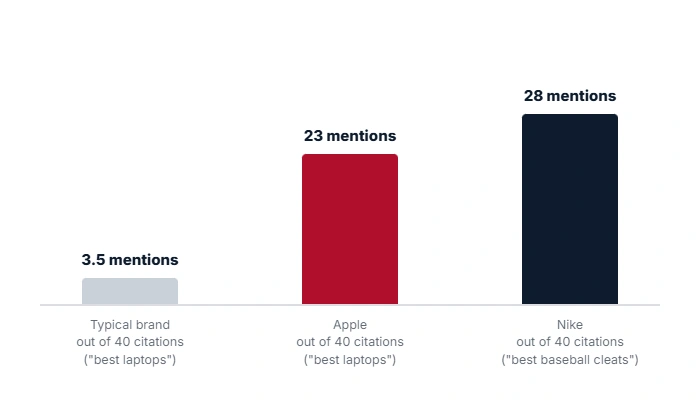
Two data points make this concrete. For “best laptops,” Apple showed 23 brand mentions across 37 citations.
That’s an extremely high density of third-party coverage. Typical brands see only 2-5 mentions.
For “best baseball cleats,” Nike ranks only #11 in traditional search. Yet Nike has near-100% AI-answer visibility, appearing in 28 of 59 citation mentions.
One more wrinkle: the page AI platforms cited wasn’t the page ranking in traditional search. There was no direct link between the two.
The practical takeaway: your best-ranking page may not be your best-citing page. And one platform’s behavior won’t predict another’s.
Check where you actually show up, not just where you rank.
A 3-step way to diagnose your own gap
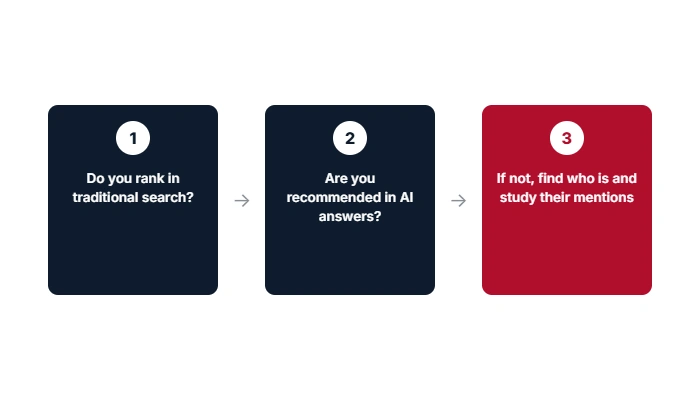
A simple 3-step diagnostic checklist for figuring out where you actually stand:
- Do you rank in traditional search for your target keyword?
- Are you being recommended in AI answers for that same query?
- If not winning either, find who is. Then study where they’re getting their brand mentions, reviews, and marketing. That gap is your work list.
When you reach that third step, get concrete. Compare review counts, brand mention volume, and branded search volume against whoever’s winning.
That gap becomes your action list, not a vague sense of falling behind.
Most brands don’t have Apple-level equity to start with. So be realistic: build traditional search presence first.
Then expand deliberately into earned, third-party mentions.
How to actually start closing an AEO gap
Once you’ve run the diagnostic, the work breaks into a few concrete moves:
Audit your citation set
Search your brand name plus your core keyword. See who’s already citing you (linked or unlinked) versus who’s citing your competitors instead.
A brand mentioned across only one or two sources is high-risk. Spread your citation set across multiple sources instead of relying on one.
Once your site covers the topic well, prioritize third-party mentions over more pages
For a national or competitive term, another blog post on your own domain moves the needle less. Getting mentioned on a site AI platforms already trust and cite does more.
That’s a next step after your own coverage is solid, not a reason to skip your own site.
Treat your own site as the hub, not the whole strategy
Keep it accurate, current, and well-structured. But don’t expect it to carry AEO visibility alone the way it once carried SEO rankings.
Track reviews and branded search volume as leading indicators
They point to the same brand-equity gap the diagnostic checklist surfaces.
Keep basic technical signals in place
Schema markup and clean structured data help AI systems parse your pages correctly and match them to the right query intent. It won’t win you citations on its own (that still comes from off-site mentions), but it’s table stakes worth having.
AEO vs. SEO: frequently asked questions
Does AEO replace SEO?
No. AEO builds on SEO’s foundation. The authority-building work that earns rankings is largely the same work that earns AI citations.
Brands with strong existing SEO have an easier path into AEO visibility.
Can a brand appear in AI answers even when its website doesn’t rank for the query?
Yes. Apple is the clearest case: it ranks nowhere for “best laptops” in traditional search.
But it dominates AI answers for that query. Ranking and citation are related, but they’re not the same thing.
Does my traditional ranking predict my AI citation performance?
Not reliably. It depends on the platform.
Perplexity’s citations line up with Google’s index about 80% of the time, so strong SEO carries over there. ChatGPT is different: it doesn’t line up closely with Google, Brave, or DuckDuckGo.
Check each platform instead of assuming one predicts the rest.
How many citation sources actually matter for a given query?
Citation sets shift day-to-day. But track them over a few months, and a stable core tends to emerge: roughly 5-7 recurring sources.
Those are your highest-priority outreach targets.
How much of AEO work happens on my own website?
The recommended split is roughly 10-20% for national or competitive brands. Most of the remaining effort goes toward earned third-party mentions and citations elsewhere.
For local businesses, that ratio flips. GBP can drive most of your AI citation visibility with Google’s own products, though not with ChatGPT.
What’s the fastest way to tell if I have an AEO gap?
Run the 3-step diagnostic. Check if you rank traditionally.
Check if you’re recommended in AI answers. If neither, study where the winning brand is getting mentioned.
The takeaway
SEO and AEO aren’t two disciplines fighting for the same budget. SEO earns your page a spot in traditional results.
AEO earns your brand a spot in the answer, whether or not a page ranked to get you there. The brands winning both treat their own site as the hub.
Then they put most of their remaining effort into one goal: becoming the brand that other sites, reviews, and platforms mention on their own.