

What Is a Reading Level?
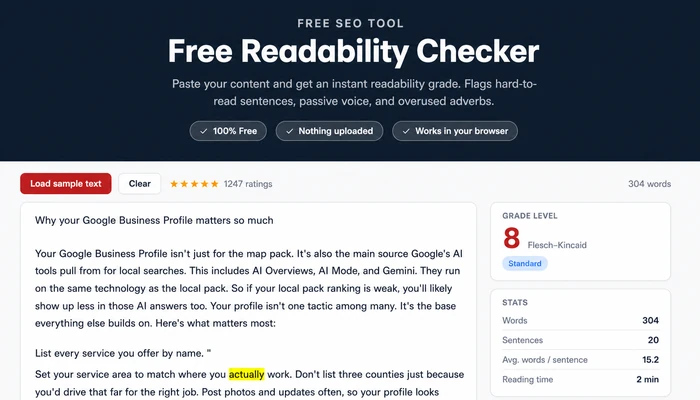
A reading level shows how hard a piece of text may be to read. Most tools report the score as a US school grade.
A Grade 8 result means the sentence and word patterns are estimated to match material for a US eighth-grade reader. It does not prove that every reader will understand the text.
Depending on the formula, tools may check:
- The length of each sentence
- The number of syllables in each word
- Word length and the share of complex words
Common measures include Flesch-Kincaid Grade Level, Flesch Reading Ease, Gunning Fog, and SMOG. Flesch Reading Ease gives an ease score.
It does not give a school grade.
Some writing tools also flag dense paragraphs, passive voice, and uncommon terms. Those checks are separate from many reading-level formulas.
These tools can help you spot hard text. Yet they cannot tell if your advice is useful or correct.
They also cannot judge your tone or the needs of your readers.
Scores may also be distorted by product names, place names, medical terms, and other needed words. A high score does not always mean the writing is poor.
Use the score as a warning light, not a final grade.
What Grade Level Should You Use?
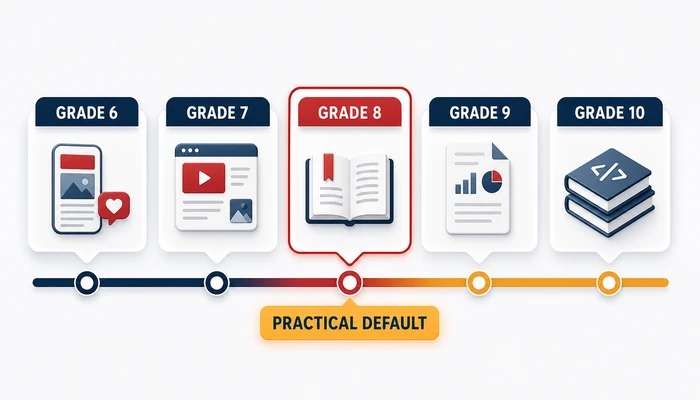
The following ranges are practical starting points rather than formal rules:
| Content type | Suggested level |
| Home pages and landing pages | Grade 6 to 8 |
| Local service pages | Grade 6 to 9 |
| Blog posts and guides | Grade 7 to 9 |
| Health information for patients | Aim for Grade 6 where practical; Grade 6 to 8 may fit when medical terms raise the score |
| Business-to-business content | Grade 8 to 10, depending on the reader |
| Technical or professional guides | Grade 9 or higher when specialist terms are needed |
Grade 8 is a sound default for a broad audience. The US Environmental Protection Agency tells its writers to target Grade 8 for non-technical pages.
It also calls for short sentences, short paragraphs, and common words. This is an EPA standard, not a rule for every website. See the EPA web-writing standard.
Patient health content may need a lower target. Research on patient education cites recommendations around Grade 6 to 8.
Some health groups favor Grade 6. Review the patient-education research.
Do not treat these ranges as strict limits. A short section may score higher because it uses needed terms.
The full page can still be clear.
Why Does Clear Website Copy Matter?
Web users often scan headings, links, and key phrases first. They then choose which parts to read closely.
Clear writing helps them:
- Find an answer faster
- Compare their options
- Follow each step
- Understand a new idea
- Choose what to do next
It may also help people who speak English as a second language. Plain language may reduce barriers for some people with learning or reading disabilities.
Yet a reading-level score alone does not make a page accessible.
WCAG 2.2 includes a Level AAA rule about reading level. When text needs more than nine years of school, it calls for added help or a simpler version.
This is not required for basic WCAG conformance. Read the W3C guidance.
Does Reading Level Help SEO?
Google does not set one grade level for every web page. Its guidance asks sites to create helpful content for real people.
The content should answer the reader’s question and be easy to follow. Read Google’s people-first content guidance.
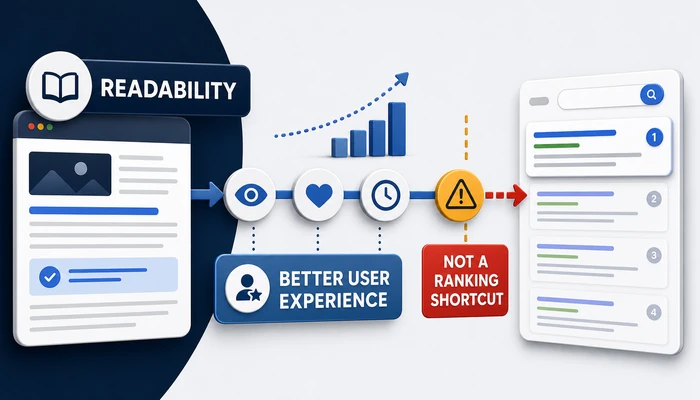
A lower score does not lead to higher rankings on its own. Grade 7 copy is not always better than Grade 9 copy.
Reading level supports a good user experience. It is not a shortcut to better search results.
Focus on the reader first. Then use the free readability checker to find gaps and hard text.
Can Your Reading Level Be Too Low?
Yes. Simple writing can go too far.
If you remove too much detail, the text may become vague. You may also change the meaning of a legal, health, or technical claim.
Keep a hard term when your reader needs it. Define it in plain words when you first use it.
For example:
OAuth is a way to give one service limited access to another account. It does this without sharing the user’s password.
The term stays in the copy. The next sentence explains what it does.
Your aim is not to remove every long word. Your aim is to remove needless effort.
How to Pick the Right Reading Level
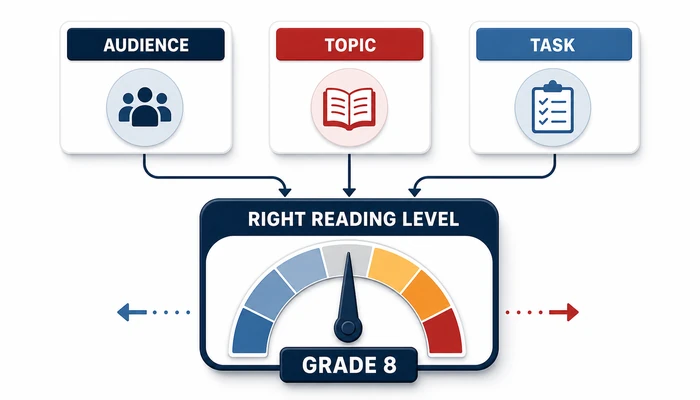
Know who will read the page
Start with the main reader. Think about what they know and why they came to the page.
Ask:
- Do they know the topic well?
- Are they likely to know industry terms?
- Are they reading while under stress?
- Do they need a quick answer or a full guide?
- Could English be their second language?
A person can be highly trained and still prefer clear text. Experts are busy too.
Know what the reader must do
Your home page has a simple job. It should say what the business does and who it helps.
A safety guide has a harder job. It may need exact terms, warnings, and clear steps.
Match the level to the task. Important actions need direct language.
Keep terms that protect the meaning
Do not replace an exact term with a weak one just to lower a score. Keep the term and explain it.
Use the same term each time. This makes the page easier to follow.
Test more than one section
Check the opening, main answer, and call to action. A score for the whole page may hide one very hard part.
You can also use more than one tool. Each test uses a different formula, so the scores may not match.
Ask a real reader
Give the draft to someone like your target reader. Ask them to explain the main point in their own words.
Then ask:
- Was any part hard to understand?
- Could they find the main answer?
- Did they know what to do next?
This feedback matters more than one tool score.
How to Make Website Content Easier to Read
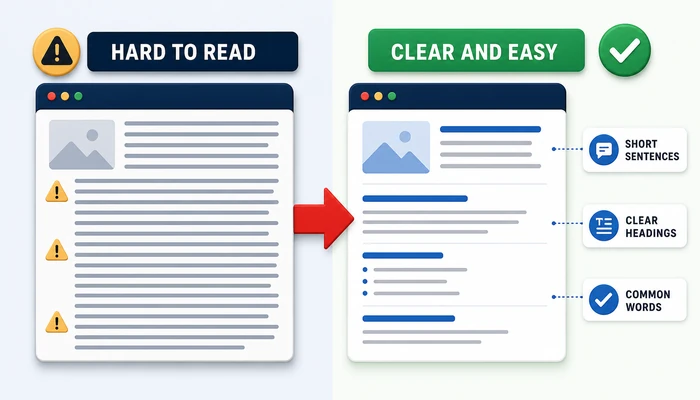
Give the answer first
Do not make readers wait for the main point. Answer the question near the top.
Add more detail below it.
Shorten long sentences
Keep one main idea in each sentence. Split a sentence when it has too many parts.
Use common words
Use “help” instead of “facilitate.” Use “buy” instead of “purchase.” Keep formal words only when they add meaning.
Add clear headings
Each heading should tell readers what comes next. Avoid vague headings such as “More Information.”
Keep paragraphs short
Short blocks of text are easier to read on a phone. The same principle matters when you optimize knowledge-base content for search.
Try to cover one point in each paragraph.
Use active voice
“Send the form by Friday” is clear and direct. “The form should be sent by Friday” is less direct.
You do not need to remove all passive voice. Use the form that makes the point easiest to understand.
Check the page design
Good reading is not only about words. The page also needs clear type, strong contrast, useful lists, and enough space.
You can also compress and resize page images to support faster loading.
A Simple Rule to Follow
For a broad audience, start within Grade 6 to 9. Grade 8 is a useful default for many non-technical pages.
Raise the level when the topic needs exact or expert terms. Lower it when the audience is broad, stressed, or new to the topic.
If you publish through an automated CMS workflow, review how Zea’s WordPress blog automation system validates content before it goes live. Before you publish, ask:
- Is the main answer easy to find?
- Are hard terms explained?
- Are the headings clear?
- Does each paragraph make one point?
- Can the reader tell what to do next?
- Did simple wording change any facts?
A tool can score your copy. Only a reader can tell you if it works.
For help connecting clear copy with search strategy, learn more about Zea Gatdula’s structured SEO approach.
Frequently Asked Questions
Is Grade 8 always the best level?
No. Grade 8 is a useful starting point for a broad audience. Your topic and readers may need a lower or higher level.
Does Grade 8 mean writing for children?
No. The score shows how hard the text may be to read. It does not define the age of your audience.
Is reading level a Google ranking factor?
Google does not give sites a required grade-level score. Clear content can help users, but a lower score does not promise better rankings.
Should I remove all technical terms?
No. Keep terms that your readers need. Explain each term in simple words when you first use it.
Which reading level tool should I use?
Flesch-Kincaid is a useful place to start. Check key sections and use human feedback as well.